


Andrej Karpathy has become one of the most influential naming authorities in artificial intelligence.
A phrase from him can become an industry category. A casual description can become a headline. An observation can travel through podcasts, venture-capital conferences, company presentations, newsletters, social media, and product marketing until the terminology appears inseparable from the person who named it.
But naming a practice is not the same as originating it.
Observing a workflow is not the same as inventing it.
Explaining what other people are already doing is not the same as building the underlying system.
All of these activities may have value. Observation, synthesis, explanation, engineering, naming, and popularization are legitimate contributions. They are simply not interchangeable, and they should not receive interchangeable credit.
This article asks Andrej Karpathy to document the difference.
This is not a question of whether he can build
Karpathy has a substantial technical record.
He was a founding member of OpenAI, served as Tesla’s director of artificial intelligence, and has published educational material demonstrating neural networks and language models from first principles. His own Neural Networks: Zero to Hero course is explicitly built around implementing neural networks from scratch in code.
That history should be acknowledged.
It is also precisely why the questions in this audit matter.
Karpathy is not an anonymous commentator casually describing trends. He possesses elite institutional credentials, a massive public platform, access to influential companies, and the ability to direct how the technology industry understands emerging behavior.
His words carry professional and economic consequences.
When someone with that degree of authority introduces a term, the industry often stops asking who first developed the underlying practice. Attention shifts toward the person who successfully described it.
That is not an adequate system of provenance.
The distinction AI reporting keeps collapsing
There are at least six separate contributions that routinely get compressed into the single word innovation:
Originating a method.
Independently discovering it through engineering.
Implementing an existing idea successfully.
Observing an existing practice.
Naming or formalizing that practice.
Popularizing it to a larger audience.
A person may contribute at several of these levels. But the public deserves to know which contribution actually occurred.
An inventor should be recognized as an inventor.
An engineer should be recognized as an engineer.
An observer should be recognized as an observer.
A synthesizer should be recognized as a synthesizer.
A popularizer should be recognized as a popularizer.
The problem begins when the visibility of the final participant erases the work of everyone who came before.
The recurring origin story
The central question of this audit comes from a pattern visible across Karpathy’s public commentary.
Many recent explanations appear to begin not with:
I was building a system, encountered a technical problem, conducted experiments, and developed this solution.
Instead, they often begin with some version of:
I noticed people working this way.
I saw someone using these tools like this.
We are seeing developers behave this way.
Companies appear to follow this pattern.
People have started doing this.
Those statements are not admissions of misconduct.
They are origin statements.
And origin statements matter.
When the explanation begins with observing other people already performing a workflow, the underlying practice necessarily existed before the observer named it.
The next question must therefore be:
Who were those people?
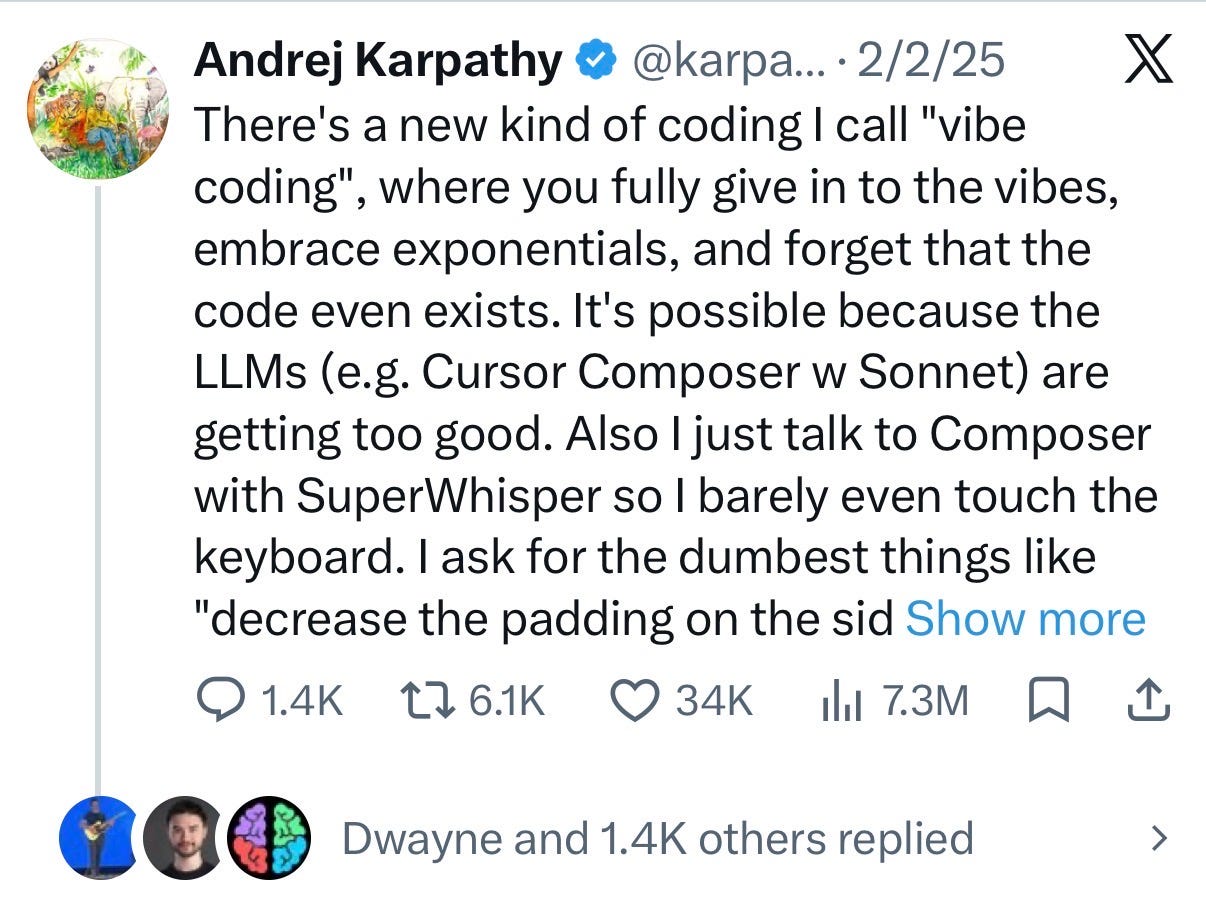
Evidence Block 1: Vibe coding
Insert exact quote:
“There's a new kind of coding I call "vibe coding", where you fully give in to the vibes, embrace exponentials, and forget that the code even exists.”
Date:
February 2025
Source:
X Post
What existed before the label:
???
Earliest practitioners presently identified:
???
What Karpathy demonstrably contributed:
[TERM / DESCRIPTION / AMPLIFICATION]
Who he credited:
???
The purpose of this section is not to argue that Karpathy was forbidden from coining a phrase. The question is whether the media and technology industry properly distinguished between inventing the workflow and giving it a memorable name.
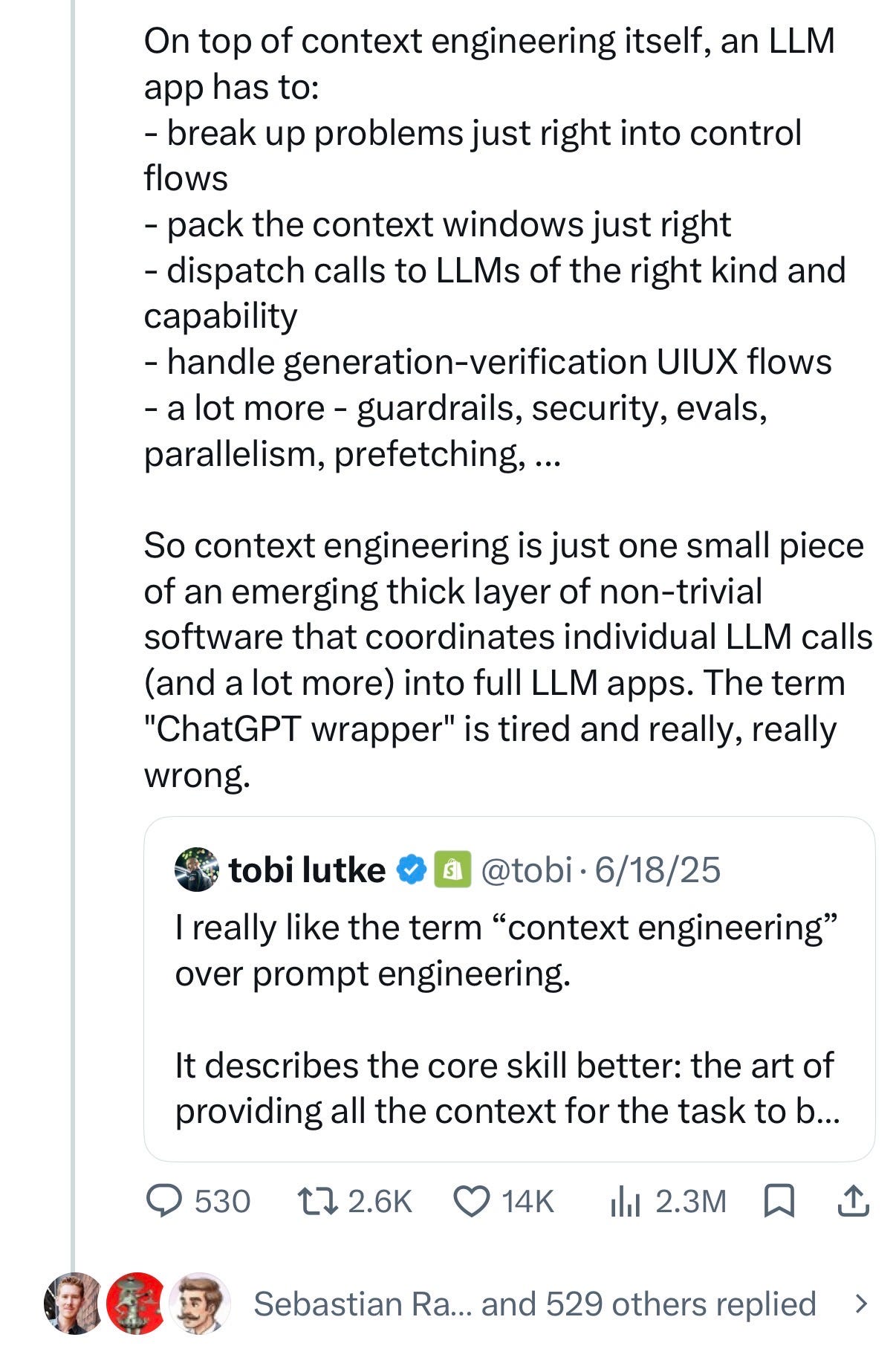
Evidence Block 2: Context engineering
Insert exact quote:
Date:
6-18-25
Source:
Toni Lutke
Observed practice:
Observed Another Person’s Term
2 million Bookmarks for Mr.K 2k for Lutke
Earlier documented SOURCE
“I really like the term “context engineering” over prompt engineering.
It describes the core skill better: the art of providing all the context for the task to be plausibly solvable by the LLM.“ - Toni Lutke
Karpathy’s documented addition:
X POST
+1 for "context engineering" over "prompt engineering".
People associate prompts with short task descriptions you'd give an LLM in your day-to-day use. When in every industrial-strength LLM app, context engineering is the delicate art and science of filling the context window with just the right information for the next step. Science because doing this right involves task descriptions and explanations, few shot examples, RAG, related (possibly multimodal) data, tools, state and history, compacting... Too little or of the wrong form and the LLM doesn't have the right context for optimal performance. Too much or too irrelevant and the LLM costs might go up and performance might come down. Doing this well is highly non-trivial. And art because of the guiding intuition around LLM psychology of people spirits.
On top of context engineering itself, an LLM app has to:
- break up problems just right into control flows
- pack the context windows just right
- dispatch calls to LLMs of the right kind and capability
- handle generation-verification UIUX flows
- a lot more - guardrails, security, evals, parallelism, prefetching, ...
So context engineering is just one small piece of an emerging thick layer of non-trivial software that coordinates individual LLM calls (and a lot more) into full LLM apps. The term "ChatGPT wrapper" is tired and really, really wrong.
Attribution provided:
Yes
Evidence Block 3: Agents or agentic engineering
Insert exact quote:
The one thing I'd add is that at the time, LLM capability was low enough that you'd mostly use vibe coding for fun throwaway projects, demos and explorations. It was good fun and it almost worked. Today (1 year later), programming via LLM agents is increasingly becoming a default workflow for professionals, except with more oversight and scrutiny. The goal is to claim the leverage from the use of agents but without any compromise on the quality of the software. Many people have tried to come up with a better name for this to differentiate it from vibe coding, personally my current favorite "agentic engineering":
- "agentic" because the new default is that you are not writing the code directly 99% of the time, you are orchestrating agents who do and acting as oversight.
- "engineering" to emphasize that there is an art & science and expertise to it. It's something you can learn and become better at, with its own depth of a different kind.
In 2026, we're likely to see continued improvements on both the model layer and the new agent layer. I feel excited about the product of the two and another year of progress.
Date:
2-4-26
Source:
X
What practitioners were already doing:
???
What terminology or framework was later introduced:
Absorb “Agentic Engineering”
What was technically new:
Andrej amplified the innovation
What was renamed, synthesized, or popularized:
Agentic Engineering
Evidence Block 4: Loops, autoresearch and AI-assisted research
Karpathy has publicly discussed systems in which agents perform experiments, gather results, modify a research process, and continue iterating. Public descriptions of AutoResearch characterize it as an agent closing a research loop across experimentation, training, and optimization.
That may represent real engineering work.
The audit still requires a more exact origin history.
Insert exact quote:
“By May 2026, “The Karpathy Loop” was no longer appearing as a tentative nickname. Search results presented it as an established technical category, complete with explainers, implementation guides, and claims that the pattern could be applied across domains. Yet the visible articles do not establish the provenance of the label. They do not identify who coined it, its earliest public use, the prior systems it builds upon, or the specific innovation that justifies attaching Karpathy’s name to a general propose-test-evaluate-repeat workflow. The name appears official because it has been repeated, not because its origin has been demonstrated.
Repetition is not provenance. Search ranking is not proof of invention.”
Then answer:
What system did he personally build?
What part of it was technically original?
Which autonomous research loops already existed?
Which outside systems did he study?
Were those systems cited?
Was the contribution a new architecture, a new implementation, a new interface, a new name, or a new audience?
Evidence Block 5: Software 3.0
In his 2025 presentation, Karpathy described large language models as a new kind of computer programmed through natural language and called this shift “Software 3.0.” He also discussed partial autonomy, human-AI collaboration loops, vibe coding, and the need to build digital infrastructure for agents.
The presentation was influential.
Influence is not the same inquiry as provenance.
Insert exact
“ ”
Other Sources pre-dating “Software 3.0”
CODE™️.eth
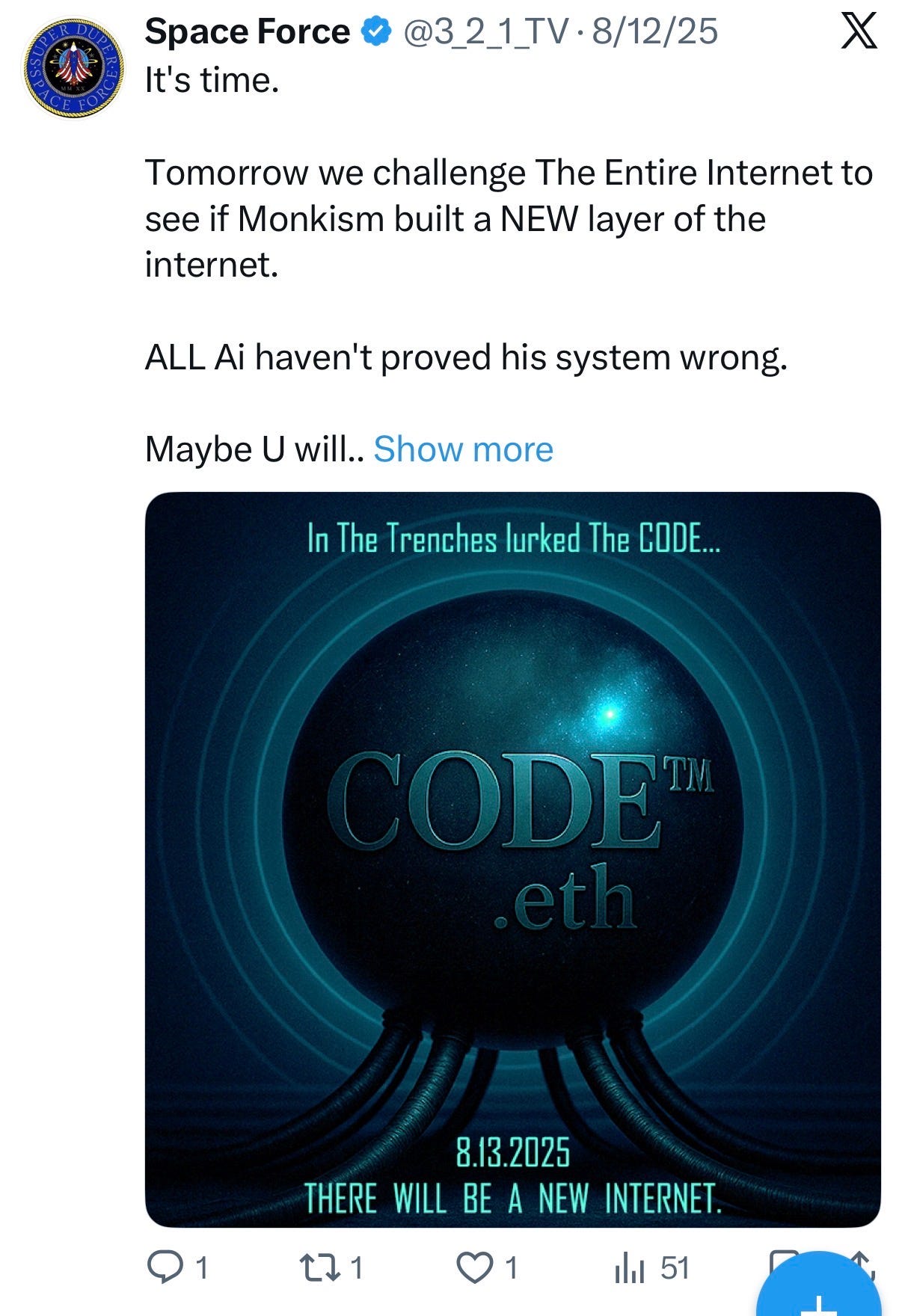

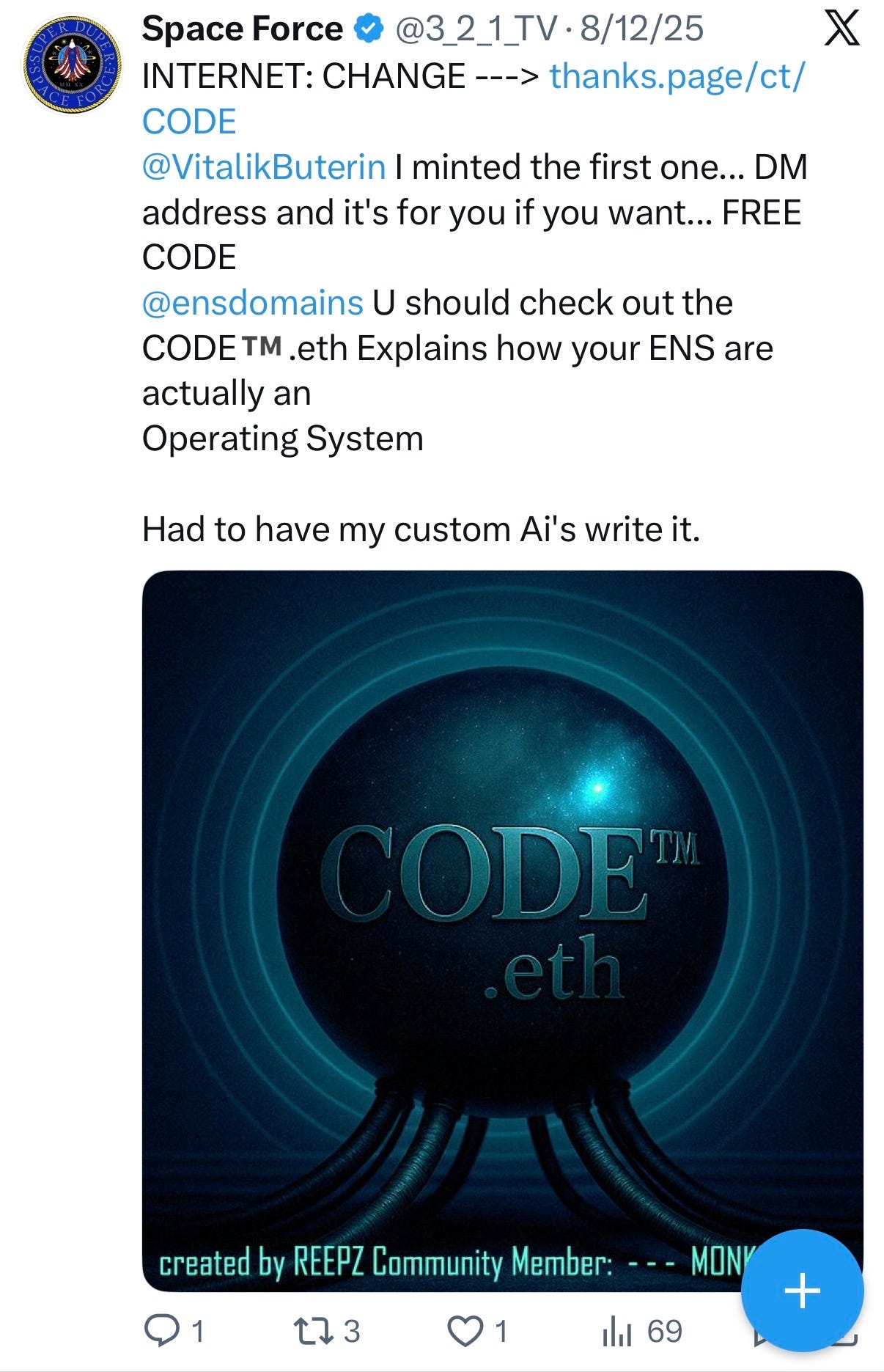
Independent Prior Public Record
Months before the public introduction of Software 3.0, I was already publicly documenting CODE™ as an AI-driven operating-system architecture. The posts below, dated August 2025, reference a serverless coding system, custom AI, and an operating-system model built around CODE™ and ENS infrastructure.
I include this screenshot not to argue that Software 3.0 originated from my work, but to establish an independently dated public record. Readers can compare the timelines and underlying concepts for themselves.
Figure X. Public CODE™ posts (August 2025).
The pattern shows consistently independent or smaller account users having very similar concepts, terms, and ideas, sometimes ADMITTEDLY absorbed by Andrej Karpathy while consistently NOT citing sources, NOT documenting how he developed his conclusions, & often proudly saying he is done with certain terms and establishing “new ones”. This is a pattern of erasing those that built the foundation & due to his prestige, large audience, & access to pretty much ANY USER DATA on Workflows, innovation, and experimental ideas making positions of authority in these frontier ai companies “Funnels of Innovation”.
Then document:
Which capabilities were already being used publicly?
Which conceptual precedents existed?
Which developers had already described natural language as a programming interface?
What was distinctive about his formulation?
Did he introduce new engineering, a new taxonomy, or a highly effective synthesis?
Calling something “Software 3.0” may be useful. The usefulness of the name does not establish ownership of every practice collected beneath it.
The naming machine
The modern AI industry has developed a predictable process.
Independent developers, artists, researchers, open-source communities, small businesses, and users develop ways of working.
Their activity may be fragmented. Their terminology may be inconsistent. Their audiences may be small. They may possess functioning systems without the institutional influence required to define an industry category.
A prominent figure then observes the behavior, gives it a concise name, and communicates it to a powerful network.
Media organizations repeat the phrase.
Investors adopt it.
Companies build product categories around it.
Conference organizers frame panels around it.
The person who named the practice becomes publicly associated with its creation, while the people who demonstrated the underlying workflow become invisible & who actually developed the foundational principles most likely already had names for THEIR proprietary systems which he did NOT consult or collaborate with to see if perhaps THEIR terminology is more apply suited then having their work flows and formulas named after someone they NEVER knew even existed.
That sequence does not require a conspiracy.
It only requires an industry that confuses visibility with origin.
Anthropic raises the stakes
Karpathy announced in 2026 that he had joined Anthropic, describing the next several years of frontier language-model development as especially formative.
Anthropic is not merely a publishing platform or academic department. It develops Claude and conducts frontier research across model training, autonomous systems, interpretability, economic impacts, and AI-assisted research. Anthropic itself publicly identifies autonomous AI research and development as an important governance and technical frontier.
That institutional position makes provenance more important.
When a public commentator names a workflow, the result may be a popular phrase.
When a frontier laboratory formalizes a workflow, the result may become:
a research direction,
an internal system,
a product strategy,
a hiring category,
an industry standard,
a source of professional advancement,
or part of the development process for future models.
The question is no longer merely who created a catchy term.
The question is whether powerful AI companies maintain adequate records showing where the practices they formalize originally came from.
What access produced the observation?
When Karpathy says he observed people, developers, companies, or workflows, the public should be able to understand the source of that observation.
Was it based on:
public social-media posts,
public repositories,
conference demonstrations,
conversations with developers,
internal company research,
customer activity,
aggregated usage patterns,
private product interactions,
or informal professional networks?
These sources are not equivalent.
A practice discovered through public research can be independently reviewed.
A practice identified through privileged institutional access may not be visible to the people whose behavior generated the insight.
This article does not assert that Karpathy improperly accessed private data. No such conclusion should be made without evidence.
It asks whether the source of each observation will be disclosed.
That is a fair question whenever an observed behavioral pattern is converted into recognized innovation.
The media’s responsibility
The press frequently uses words such as:
invented,
introduced,
created,
pioneered,
developed,
coined,
popularized,
and defined
as though they mean the same thing.
They do not.
A reporter describing Karpathy as the person who coined a term may be making an accurate statement about terminology.
A reporter describing him as the person who invented the underlying workflow is making a much larger claim.
That claim requires evidence.
Reporting should identify:
the first known use of the term,
the first known implementation of the practice,
the first public demonstration,
the technical contribution,
and the earlier work acknowledged by the person receiving credit.
Without that distinction, journalism becomes part of the naming machine.
The audit standard
Every major innovation attached to a prominent AI figure should be evaluated using the same record.
1. Origin
What precise problem was being solved?
Who first identified it?
2. Development
What did the credited person personally design, code, test, or implement?
3. Prior art
Which earlier public systems performed the same underlying function?
4. Observation
Did the concept emerge from watching other users, developers, organizations, or communities?
5. Attribution
Who was named, linked, thanked, cited, or compensated?
6. Distinct contribution
Was the contribution:
invention,
engineering,
synthesis,
terminology,
communication,
productization,
or amplification?
7. Institutional benefit
What professional, commercial, reputational, or research value followed?
This standard does not diminish legitimate contributions.
It identifies them accurately.
Thirteen questions for Andrej Karpathy
Which concepts currently associated with your name originated through systems you personally engineered?
What dated code, research notes, experiments, repositories, prototypes, or demonstrations document each origin?
Which concepts began with your observation of other people’s behavior or workflows?
Who were the people, developers, companies, or communities you observed?
Were the observed workflows public, private, internal, customer-derived, aggregated, or shared directly with you?
What earlier implementations did you review before naming or formalizing each concept?
Which earlier practitioners did you contact or credit?
What exactly did you add in each case: architecture, code, research, terminology, synthesis, productization, or publicity?
When articles inaccurately imply that you invented a practice you only named or popularized, do you correct the record?
What standards do you use to distinguish an original invention from a pattern you observed in the work of others?
What provenance policies govern ideas developed from user behavior or institutional access?
Can independent researchers reconstruct the development history of your recent frameworks from public evidence?
Will you publish a source ledger identifying the people, systems, and prior work that informed the concepts attached to your name?
Why this matters beyond Karpathy
This audit is not only about one engineer.
Independent creators increasingly build with AI in public.
They publish workflows, prototypes, diagrams, terminology, software, research notes, videos, books, posts, and functioning systems. Many have little access to media, capital, conferences, prestigious laboratories, or professional networks.
Their work may remain nearly invisible until a powerful person notices it.
Then the same underlying idea can return with cleaner terminology, institutional backing, press attention, and a prestigious name attached.
By the time the original creator objects, the public record appears to show that the powerful person introduced the concept.
The creator is then asked to prove a history that the press never bothered to document.
That burden is backward.
Institutions receiving the recognition should be expected to maintain provenance.
Observation is not invention
There is nothing inherently wrong with observing how people work.
There is nothing inherently wrong with recognizing a pattern.
There is nothing inherently wrong with giving that pattern a useful name.
There is nothing inherently wrong with teaching it to a larger audience.
But the credit should match the contribution.
When the origin story begins with:
I saw people doing this,
the story cannot honestly end with:
therefore I invented it.
It should continue:
Who were they?
What had they already built?
What did I learn from them?
What did I add?
How were they credited?
That is not hostility toward innovation.
That is the minimum documentation required to preserve it.
The challenge
Andrej Karpathy has spent years explaining artificial intelligence to the public.
Now he should explain the provenance of the innovations attached to his name.
For each concept:
What did you personally build?
What did you observe others doing?
Who were those people?
What sources informed the concept?
What part was technically new?
What part was synthesis?
What part was naming?
What part was amplification?
And who received credit before the terminology became valuable?
You think you’re good with words. Now use them to be equally good with provenance.
IGMUS ←Where your Receipts, here are mine
Imagination Generation Machined Utility System